
How to Choose the Best IVF Doctor in Kanpur: A Complete Decision Guide
Medically reviewed by: Dr. Astha Singh, MBBS, DGO, DNB (Obs & Gynae), MNAMS, FNB (Reproductive Medicine – MAMC, LNH, New Delhi), IVF & Infertility Specialist
Last medically reviewed: July 2026
Finding out that you may need IVF (in vitro fertilization) can bring up a mix of emotions all at once. Relief that there’s a path forward. Anxiety about the process. And a very practical question that often feels surprisingly hard to answer: how do you actually pick the right doctor?
Unlike choosing a doctor for a routine checkup, this decision affects your health, your finances, and often your emotional wellbeing over many months. In a city like Kanpur, where the number of fertility clinics has grown steadily over the past few years, patients are often left comparing glossy websites and success rate claims without knowing what actually matters.
This guide is meant to cut through that noise. It won’t tell you which specific doctor to pick. Instead, it will walk you through exactly what to look for, what questions to ask, and what red flags should make you pause, so you can make this decision with confidence rather than guesswork.
What You'll Learn
- What IVF involves, step by step, and when doctors typically recommend it
- How IVF clinics in India are legally regulated, and why that matters to you
- Why the choice of doctor (and clinic) has a real impact on your outcome
- What ovarian reserve testing (AMH and AFC) can and can’t tell you
- The specific qualifications and traits of a trustworthy IVF specialist
- Red flags that suggest you should look elsewhere
- What the evidence actually says about optional “add-on” treatments
- How to compare doctors and clinics side by side, using an interactive tool
- What realistically affects IVF costs in Kanpur
- Common myths about IVF, and what the evidence actually says
Understanding IVF and When It's Recommended
IVF is a fertility treatment where an egg and sperm are combined outside the body, in a laboratory, to form an embryo. That embryo is then transferred into the uterus in the hope that it implants and develops into a pregnancy. It’s a more involved process than medication-based treatments, which is exactly why the skill of the medical team matters so much.

How Doctors Define Infertility
Before recommending IVF, most specialists work from a standard clinical definition of infertility: the World Health Organization describes infertility as a disease of the reproductive system marked by the inability to achieve a pregnancy after twelve months or more of regular, unprotected intercourse. Reproductive medicine bodies such as the American Society for Reproductive Medicine generally recommend shortening that window to six months for women aged 35 and older, since egg quantity and quality decline more quickly with age. Doctors in India generally follow this same age-adjusted logic when deciding how soon to start testing.
Doctors typically recommend IVF for a range of reasons, including:
- Blocked or damaged fallopian tubes
- Polycystic ovary syndrome (PCOS) that hasn’t responded to simpler treatments
- Male factor infertility, such as low sperm count or motility
- Unexplained infertility after other treatments haven’t worked
- Age-related decline in egg quantity or quality
- Failed cycles of IUI (intrauterine insemination)
It’s worth understanding that IVF isn’t always the first recommendation. Many fertility specialists will suggest simpler treatments first, like ovulation induction or IUI, before moving to IVF. If a doctor recommends jumping straight to IVF without discussing your full history, it’s reasonable to ask why.
The IVF Process, Step by Step
Knowing the basic sequence makes it much easier to ask informed questions at your consultation, and to understand why some doctors recommend one variation over another.
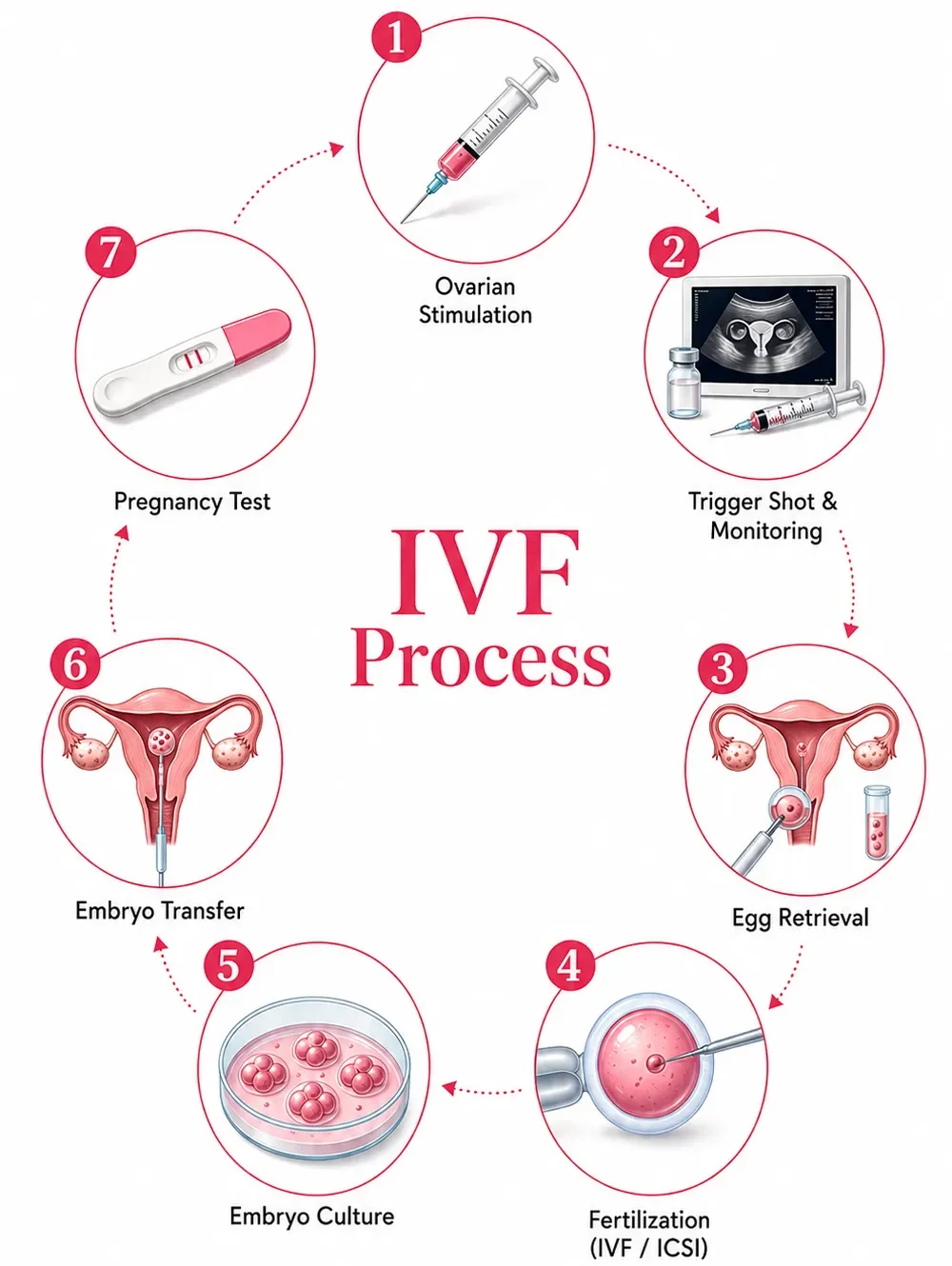
Ovarian stimulation
Daily hormone injections encourage the ovaries to develop multiple eggs in a single cycle, rather than the usual one.
Trigger shot and monitoring
Ultrasound and blood tests track follicle growth; once follicles are ready, a “trigger” injection finalizes egg maturation.
Egg retrieval
A short, sedated procedure removes the mature eggs directly from the ovaries.
Fertilization
Eggs are combined with sperm in the lab, either through conventional insemination or through ICSI (intracytoplasmic sperm injection), a technique where a single sperm is injected directly into an egg, often used for male factor infertility.
Embryo culture and grading
Fertilized eggs are grown in the lab for three to five days, sometimes to the blastocyst stage, and embryologists grade them based on cell number, symmetry, and appearance to help choose the most promising ones.
Embryo transfer
One embryo (occasionally two, depending on your case) is placed into the uterus, either fresh in the same cycle or frozen and transferred in a later cycle (a frozen embryo transfer, or FET).
Luteal phase support and pregnancy test
Medication supports the uterine lining after transfer, followed by a blood test roughly two weeks later to check for pregnancy.
Every clinic personalizes this sequence based on your diagnosis, so it’s reasonable to ask your doctor which specific variation they’re recommending for you, and why.

How IVF Is Regulated in India
IVF and other assisted reproductive procedures in India are governed by the Assisted Reproductive Technology (Regulation) Act, 2021, overseen with guidance from the Indian Council of Medical Research (ICMR). Under this framework, ART clinics and banks are required to register with the relevant authorities, maintain detailed treatment records, and disclose their charges to patients upfront rather than adding undisclosed costs later in treatment. This regulatory layer exists specifically to protect patients, so it’s entirely reasonable, and a good sign of a clinic’s legitimacy, to ask whether they are registered under this Act.
Why the Right IVF Doctor Matters More Than You Think
It’s tempting to think of IVF as a standardized procedure that works the same way regardless of who performs it. In reality, outcomes depend heavily on the doctor’s experience, the accuracy of the initial diagnosis, and the quality of the embryology lab behind the scenes.
Diagnosis accuracy and personalized protocols
IVF isn’t a single fixed protocol. Medication types, dosages, and timing are adjusted based on your age, hormone levels, ovarian reserve, and any underlying conditions. An experienced specialist is more likely to catch subtle issues, like a thyroid imbalance or a clotting disorder, that could affect your results if left unaddressed.
Emotional and financial impact
Each IVF cycle takes an emotional and financial toll. A doctor who sets realistic expectations from the start, rather than overpromising, can meaningfully reduce the stress of the process, even if the honest answer is sometimes harder to hear.
The embryology lab matters as much as the doctor
This is something many patients don’t realize until later. The lab where eggs are fertilized and embryos are cultured plays a massive role in success rates. A skilled doctor working with an outdated or poorly maintained lab may still see disappointing results. When evaluating a clinic in Kanpur, it’s worth asking about the lab’s equipment and how experienced the embryology team is, not just the doctor’s credentials.

Understanding Ovarian Reserve Testing (AMH and AFC)
Somewhere early in your evaluation, your doctor will likely order tests to estimate your ovarian reserve, most commonly Anti-Müllerian Hormone (AMH), a blood test, and Antral Follicle Count (AFC), an ultrasound count of small follicles in the ovaries.
Here’s the part that surprises a lot of patients: reproductive medicine bodies like the American Society for Reproductive Medicine note that these markers are good at predicting roughly how many eggs a stimulation cycle might yield, but they are poor independent predictors of whether you’ll actually be able to conceive. In other words, a lower AMH result is useful for planning your protocol, but it is not, on its own, a verdict on your chances of pregnancy, and professional guidance specifically cautions against using it alone to deny someone access to treatment.
A good specialist will explain your ovarian reserve results in that context, as one input among several, rather than presenting a single number as a final answer.
Signs of a Good IVF Specialist
Here’s what tends to distinguish a genuinely capable, trustworthy IVF doctor from one who just looks good on paper.

Qualifications and training
Look for a doctor with a recognized qualification in reproductive medicine or gynecology with fellowship training in infertility or IVF. Membership in a professional body focused on reproductive medicine (such as India’s national society for assisted reproduction) is a reasonable additional signal, though it shouldn’t be the only factor you consider.
Experience with complex cases
General experience is good, but experience with cases similar to yours matters more. If you have a specific condition like low AMH, recurrent implantation failure, or male infertility, ask directly how often the doctor handles cases like yours.
Communication style
A good specialist explains things in plain language, welcomes your questions, and doesn’t rush you out of the consultation. If you leave your first appointment more confused than when you walked in, that’s worth noting.
Transparency about success rates and test results
A trustworthy doctor explains success rates and ovarian reserve results in context, based on your age and diagnosis, rather than quoting a single impressive-sounding number or an alarming test result without explanation.
Willingness to involve you in decisions
You should feel like a participant in your treatment plan, not just a recipient of instructions.
Red Flags to Watch Out For
Just as important as knowing what to look for is knowing what should make you cautious.

Guarantees of success
No ethical doctor can promise IVF will work. Biology doesn’t offer guarantees, and anyone claiming certainty is overselling.
Pressure toward expensive add-ons
Be cautious if a clinic pushes multiple additional procedures or tests immediately, without clearly explaining the evidence behind each one for your specific case.
Vague or shifting cost estimates
A reputable clinic should be able to give you a reasonably clear, itemized cost breakdown upfront, as required under India’s ART regulations, including what happens if additional cycles are needed.
Rushed consultations
If your appointments consistently feel hurried, with little time for your questions, it may be a sign of how the rest of your care will go.
Reluctance to discuss failure rates, alternative options, or registration status
A doctor who only talks about success, avoids discussing what happens if a cycle doesn’t work, or is evasive about the clinic’s legal registration isn’t giving you the full picture.

IVF Add-Ons: What the Evidence Actually Shows
As you research clinics, you’ll likely come across the term “add-ons”: optional extras offered alongside standard IVF that are marketed as improving your chances of success. Common examples include endometrial scratching, hyaluronan-enriched embryo transfer media, assisted hatching, the endometrial receptivity test (commonly called ERA), and PGT-A (preimplantation genetic testing for aneuploidy, which screens embryos for chromosomal abnormalities before transfer).
Fertility regulators in other countries, most notably the UK’s Human Fertilisation and Embryology Authority, have taken the step of independently rating these add-ons based on the strength of clinical trial evidence behind each one. A recurring finding from that evidence review process is that many commonly offered add-ons do not have strong trial evidence showing they improve live birth rates, even though they are frequently offered at an additional cost.
This doesn’t mean every add-on is without merit, some may genuinely help specific patients in specific circumstances. It does mean it’s worth asking pointed questions before agreeing to pay for one:
- What specific evidence supports this add-on improving success for someone with my exact diagnosis?
- Is this recommended for everyone at this clinic, or specifically because of something in my case?
- What would you expect to happen if I chose not to add this?
Doctor vs Clinic: What Matters More in Kanpur
This is a genuinely useful distinction that many patients overlook. You’re not just choosing a doctor. You’re choosing a doctor within a specific clinic, working with a specific lab, support team, and legal registration status.
Standalone IVF centers vs multi-specialty hospitals
Standalone fertility centers often specialize deeply in reproductive medicine and may have more focused expertise and equipment. Multi-specialty hospitals may offer the reassurance of broader medical support if complications arise. Neither is automatically better. It depends on your situation and any other health conditions you have.
Questions about the lab
It’s entirely reasonable to ask a clinic about their embryology lab’s certifications, how long it has been operating, and how experienced the embryologists are. A confident, transparent answer is a good sign. Discomfort with the question is worth noting.
Registration and compliance
Under India’s ART (Regulation) Act, 2021, every clinic offering these services is required to be registered and to maintain treatment records for a defined period. Asking a clinic to confirm their registration status is a simple, concrete way to check basic accountability, and a legitimate clinic should answer this without hesitation.
Team consistency
Ask whether you’ll see the same doctor throughout your treatment or be passed between different physicians. Continuity of care can make a meaningful difference in how your protocol is managed.
Questions to Ask During Your First Consultation
Walking into your first appointment with a clear list of questions can help you evaluate the doctor while also getting the information you need.
About your diagnosis:
- What do you think is causing our fertility difficulty, based on my reports?
- Are there any additional tests you’d recommend before starting treatment?
- What does my AMH or AFC result actually mean for my treatment plan?
About the protocol:
- What treatment protocol do you recommend for my specific situation, and why?
- What medications will I be taking, and what are the common side effects?
- Would you recommend a fresh or frozen embryo transfer for my case, and why?
About add-ons and evidence:
- Are you recommending any add-on procedures, and what evidence supports them for my case?
About costs:
- What does the total cost include, and what might be billed separately?
- What happens, cost-wise, if this cycle doesn’t result in a pregnancy?
About success rates:
- What is the realistic success rate for someone with my age and diagnosis, specifically, not the clinic’s overall average?
- How do you define a “successful” cycle in the numbers you share?
About the clinic itself:
- Is this clinic registered under the ART (Regulation) Act, 2021?
- Who do I contact if I have questions or side effects between appointments?
- Will I see you consistently, or a rotating team of doctors?
How to Compare IVF Doctors in Kanpur
When you’re evaluating more than one option, it can help to lay things out side by side rather than relying on impressions alone.
Factor
What to Check
Why It Matters
Qualifications
Fellowship in reproductive medicine or infertility
Indicates specialized training beyond general gynecology
Experience
Years practicing IVF, and experience with cases like yours
General experience doesn’t guarantee relevant expertise
Lab quality
Embryology lab certifications and equipment
Directly affects fertilization and embryo development success
Registration
Confirmed registration under the ART Act, 2021
Legally required, and signals basic accountability
Success rate context
Whether rates were explained relative to your profile
Protects you from misleading averages
If your situation involves a specific complexity, such as recurrent pregnancy loss or a male infertility factor, weigh experience with that specific issue more heavily than general reputation. A note on using this table in practice: it’s genuinely hard to hold all of this in your head after two or three consultations. To make the comparison easier, we’ve built an interactive IVF Doctor Comparison Tool, provided alongside this guide, that lets you score each doctor against these factors and see the results side by side.
Understanding IVF Costs in Kanpur
IVF costs can vary noticeably between clinics, and it’s genuinely difficult to compare on price alone without understanding what’s included. Rather than offering specific figures, which vary by clinic, protocol, and individual medical needs, here’s what typically influences the total cost:

Protocol type
Some stimulation protocols require more medication than others
Medication dosage
This is often personalized and can vary considerably between patients.
Number of cycles
Costs multiply if more than one cycle is needed, which is common.
Additional procedures
Techniques like ICSI or PGT-A add to the base cost, and should be justified with a clear clinical reason in your case.
Freezing and storage
If embryos are frozen for future use, there are typically separate storage fees.
The cheapest clinic isn’t automatically the best value, particularly if a lower price reflects older equipment or less experienced staff. It’s reasonable to ask each clinic for an itemized estimate so you can compare accurately, rather than comparing headline prices alone. Remember, too, that under current regulations, clinics are expected to disclose charges upfront rather than introduce new costs mid-treatment.

Myths vs Facts About IVF
Myth: IVF always works on the first try. Fact: Success varies significantly by age, diagnosis, and individual factors. Many patients need more than one cycle, and that doesn’t mean anything was done incorrectly.
Myth: A low AMH result means IVF won’t work for you. Fact: Ovarian reserve markers like AMH predict how many eggs a cycle might yield, but professional guidance is clear that they are poor independent predictors of whether pregnancy will happen, and shouldn’t be used alone to rule treatment out.
Myth: Every add-on a clinic offers will improve your chances. Fact: Independent evidence reviews of commonly marketed IVF add-ons, most notably by the UK’s fertility regulator, have repeatedly found that many popular add-ons lack strong trial evidence of improving live birth rates. It’s worth asking for the specific evidence behind any add-on recommended to you.
Myth: IVF babies have significantly worse health outcomes. Fact: Recent long-term reviews suggest that, when looking specifically at singleton births (not twins or higher multiples) and avoiding embryo freezing complications, children conceived through IVF generally do not face significantly higher risk across most health measures compared with children conceived naturally. Some research has flagged modestly elevated risks in specific areas like neurodevelopment and cardiometabolic health that researchers are continuing to study, which is worth discussing with your doctor rather than treating as settled either way.
Myth: A higher price always means a better clinic. Fact: Price reflects many factors, including overhead and location, and isn’t a reliable stand-in for quality on its own.
Frequently Asked Questions
Q1. How do I know if an IVF doctor is genuinely experienced?
Ask directly how many years they’ve focused specifically on IVF, and how often they handle cases similar to yours. General gynecology experience is not the same as focused reproductive medicine experience.
Q2. Is it normal to consult more than one doctor before deciding?
Yes. Getting a second opinion, especially for a decision this significant, is a reasonable and common step, not a sign of distrust.
Q3. What is a normal number of IVF cycles to expect?
This varies by individual, and a good doctor should discuss this honestly with you based on your specific profile rather than giving a generic number.
Q4. What is ICSI, and will I need it?
ICSI (intracytoplasmic sperm injection) is a technique where a single sperm is injected directly into an egg, most commonly used when there’s a male infertility factor like low sperm count or motility. Whether you need it depends on your semen analysis results, which your doctor should walk you through.
Q5. Is my IVF clinic legally required to be registered in India?
Yes. Under the Assisted Reproductive Technology (Regulation) Act, 2021, ART clinics and banks in India are required to register with the relevant authorities and maintain proper treatment records. Confirming this is a reasonable, simple check.
Q6. Should I choose a clinic close to home?
Proximity matters because IVF involves frequent monitoring visits over several weeks. Balancing quality of care with convenience is a personal decision worth thinking through.
Q7. Does the doctor's gender matter for IVF treatment?
Some patients feel more comfortable with a particular gender, and that’s a valid personal preference. It doesn’t correlate with clinical skill.
Q8. What if my doctor recommends donor eggs or sperm?
This recommendation is usually based on specific diagnostic findings. It’s reasonable to ask for a clear explanation of why this option is being suggested for your case specifically.
Sources & Further Reading
This guide draws on general clinical guidance from recognized medical and regulatory bodies. It is intended for patient education and does not replace personalized medical advice.
- World Health Organization. Infertility (fact sheet). www.who.int/news-room/fact-sheets/detail/infertility
- American Society for Reproductive Medicine, Practice Committee. Testing and Interpreting Measures of Ovarian Reserve (committee opinion). www.asrm.org
- Human Fertilisation and Embryology Authority (UK). Treatment add-ons — patient information and evidence ratings. www.hfea.gov.uk
- Indian Council of Medical Research / Government of India. The Assisted Reproductive Technology (Regulation) Act, 2021. www.icmr.gov.in
- Peer-reviewed literature on long-term health outcomes of children conceived via IVF, including narrative reviews and meta-analyses published in reproductive medicine journals (e.g., Human Reproduction Update, Fertility and Sterility).
Conclusion
Choosing an IVF doctor in Kanpur is rarely a decision made in a single afternoon, and it shouldn’t be. Take the time to ask questions, compare your options thoughtfully, and pay attention to how a doctor communicates with you, not just their credentials on paper. This guide is meant to help you approach that decision with more clarity and less overwhelm, but it isn’t a substitute for a personalized consultation. Every fertility journey is different, and the right next step is to discuss your specific situation with a qualified reproductive specialist who can evaluate your individual case.